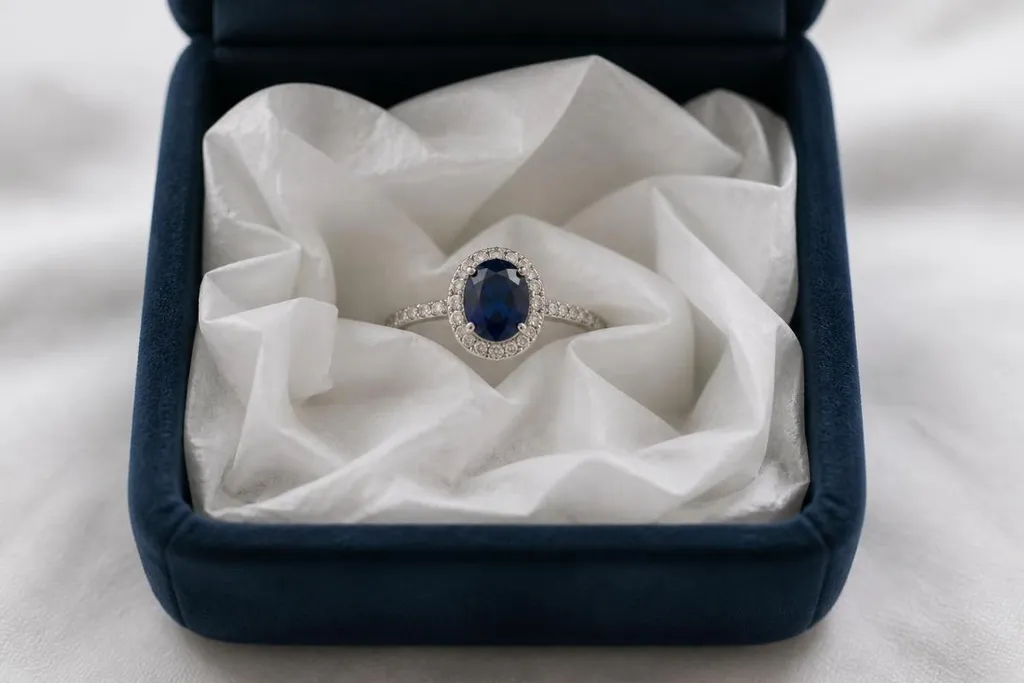
An engagement ring does not need a colourless centre stone to feel enduring. Blue sapphire has occupied an important place in fine jewellery for centuries, offering rich colour, elegant contrast and a character that is immediately recognisable. Its long history gives it traditional credibility, yet the right setting can make a sapphire engagement ring feel distinctly contemporary.
For couples considering timeless lab grown blue sapphire engagement rings, the appeal lies in more than simply choosing something different from a diamond. Lab-grown blue sapphires offer the essential chemical composition and crystal structure associated with sapphire, while their intense colour provides a strong starting point for thoughtful ring design. Cut, proportion, metal and surrounding stones all determine whether that blue feels understated, dramatic or somewhere between the two.
Why Blue Sapphire Works for an Engagement Ring
Sapphire offers an unusual combination of visual distinction and established jewellery heritage. Blue creates an obvious focal point on the hand, but it does not feel experimental or dependent on a short-lived trend.
Its practicality is another reason for its enduring use. Sapphire is corundum and ranks 9 on the Mohs scale of hardness, making it highly resistant to scratching compared with many coloured gemstones. That characteristic is valuable for an engagement ring intended for frequent wear.
Hardness should not be confused with indestructibility, however. A sapphire can still be damaged by a sufficiently strong impact, and the setting itself requires sensible care.
Colour remains the principal attraction. Depending on tone and lighting, blue sapphire can appear vivid and bright or deeper and more dramatic. Personal preference matters more than choosing the darkest or most saturated stone available. The right blue is the one the wearer will enjoy seeing in ordinary daylight as much as under jewellery-store lighting.
Shape and Size Change the Character of Blue
The cut of a sapphire influences both its outline and the way its colour is presented.
Oval cuts are particularly effective for engagement rings because their elongated shape provides graceful finger coverage while retaining soft curves. Cushion-cut sapphires have a fuller silhouette and can lend themselves naturally to romantic or vintage-influenced settings.
Round stones offer symmetry and a more traditional appearance. Emerald-style cuts take the design in a different direction, using straight lines and broader facets to create a cleaner, architectural expression of blue.
Size should be considered in context rather than as a competition. Someone may prefer a 2-carat sapphire because its larger face allows the blue colour to dominate the design. Another wearer might choose a smaller centre stone framed with diamonds because the contrast provides plenty of visual impact without requiring greater scale.
The complete composition matters more than carat weight alone.
Use Metal and Diamonds to Control Contrast
Setting design can transform the way a blue sapphire is perceived.
A solitaire allows the gemstone's colour and shape to stand alone. It can be an especially effective choice for someone who wants a modern, uncluttered engagement ring.
Adding colourless diamonds creates stronger contrast. A halo forms a bright frame around the blue centre and increases the ring's overall visual footprint. Diamond-set shoulders extend that brightness along the band, while trilogy settings can use side diamonds to emphasise the sapphire without surrounding it completely.
Metal introduces another important variable. Platinum and white gold provide a cool background that complements blue and blends naturally with colourless accent diamonds. Yellow gold creates a warmer, more pronounced contrast that can give the ring a traditional fine-jewellery character. Rose gold offers a softer and less conventional pairing.
None is universally better; each changes how the same blue stone reads on the hand.
Think About Everyday Wear and Long-Term Styling
A sapphire's hardness makes it well suited to frequent wear, but everyday habits still matter. Removing an engagement ring for heavy manual tasks reduces unnecessary knocks to both gemstone and setting.
Lotions, soap and other residues can also accumulate around the stone and diminish its brightness. Appropriate gentle cleaning helps maintain its appearance, while periodic professional inspections allow claws and other setting components to be checked.
Consider the future wedding ring too. Depending on the engagement ring's gallery and profile, a straight wedding band may sit neatly alongside it, while another design may work better with a curved or shaped band.
Final Thought
Blue sapphire engagement rings offer a genuine alternative to diamond without abandoning the sense of permanence associated with traditional engagement jewellery. Their strength lies in a combination of rich colour, established heritage and impressive everyday practicality.
A thoughtfully chosen lab-grown blue sapphire does not need excessive ornament to feel special. With the right cut, proportion, metal and setting, its colour becomes the defining feature creating an engagement ring that feels distinctive today while retaining the qualities needed to remain elegant for decades.